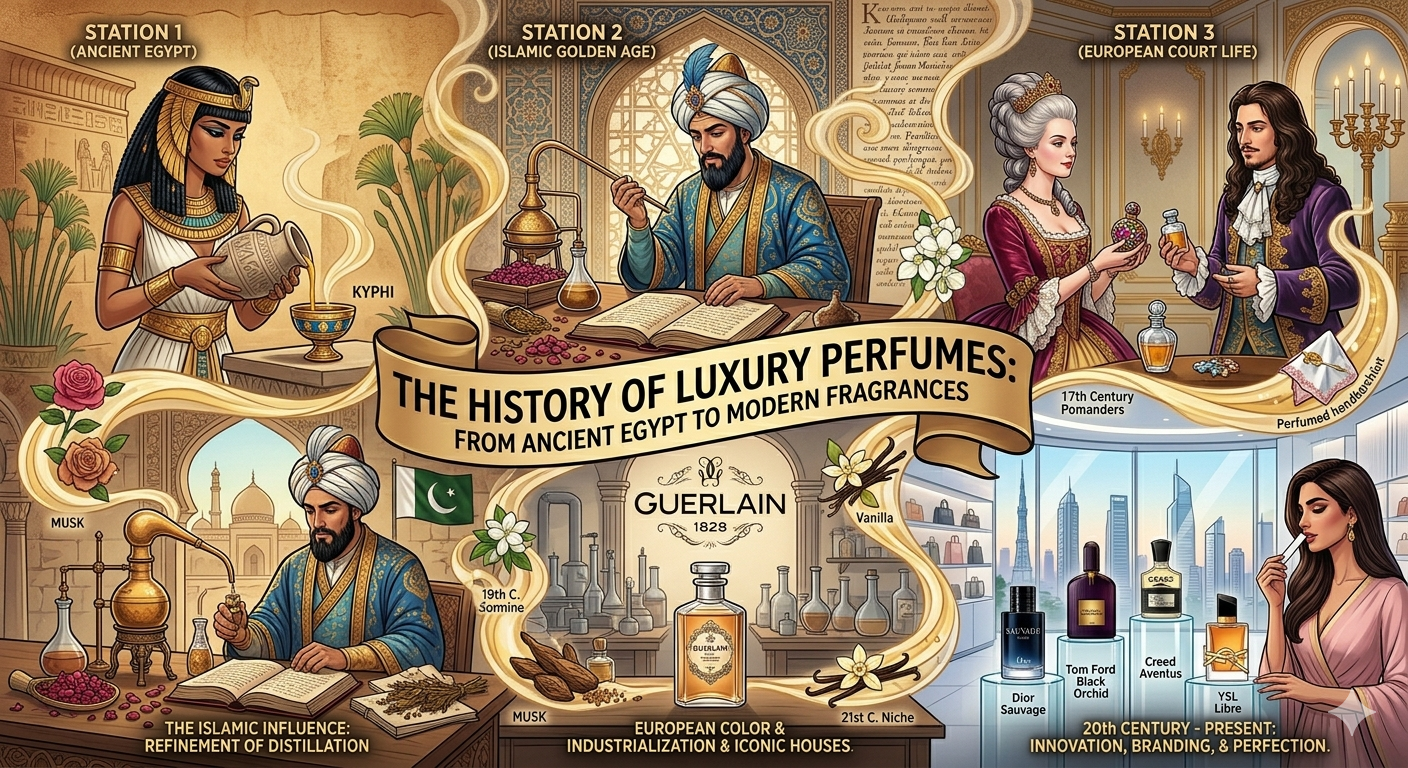

Perfume is more than a pleasant scent. Throughout history, fragrances have symbolized luxury, power, spirituality, and personal identity. From ancient civilizations to modern designer brands, perfumes have played a significant role in human culture for thousands of years.
Today, the global fragrance industry is worth billions of dollars, with luxury perfumes becoming an essential part of personal grooming and fashion. But where did it all begin?
In this article, we’ll explore the fascinating journey of perfumes—from the sacred temples of Ancient Egypt to the sophisticated fragrance houses of today.
The Origins of Perfume
The word “perfume” comes from the Latin phrase per fumum, which means “through smoke.”
The earliest perfumes were not liquid fragrances but aromatic materials burned during religious ceremonies.
Ancient civilizations used:
- Incense
- Resins
- Herbs
- Flowers
- Woods
These ingredients produced fragrant smoke believed to connect humans with the divine.
Perfume in Ancient Egypt
Ancient Egypt is widely regarded as the birthplace of modern perfumery.
The Egyptians considered fragrance a gift from the gods and used perfumes extensively in religious rituals, medicine, and personal care.
Perfumes and Religion
Priests burned aromatic substances in temples to honor deities.
Popular ingredients included:
- Frankincense
- Myrrh
- Cinnamon
- Cedarwood
These scents were believed to purify spaces and create a spiritual atmosphere.
Perfumes and Royalty
Egyptian royalty embraced fragrances as symbols of wealth and power.
One of the most famous perfume enthusiasts was:
entity[“people”,“Cleopatra”,“Queen of Ancient Egypt”]
Historical accounts suggest that Cleopatra used luxurious fragrances to enhance her image and influence.
Ancient Greece and the Art of Fragrance
The Greeks adopted many Egyptian perfume-making techniques and further refined them.
Greek perfumers began experimenting with:
- Olive oil infusions
- Floral extracts
- Herbal blends
Perfumes became associated with beauty, athletics, and social status.
Athletes often applied scented oils after competitions and public baths.
Perfume in Ancient Rome
The Romans elevated perfume use to new levels.
Fragrances became common in:
- Public baths
- Homes
- Clothing
- Ceremonies
Wealthy Romans spent significant amounts on imported aromatic ingredients.
Perfume became a daily luxury rather than a privilege reserved for royalty.
The Rise of Perfume in the Islamic Golden Age
The development of modern perfumery owes much to scholars and scientists of the Islamic Golden Age.
Innovation in Distillation
One of the most important contributions was the refinement of distillation techniques.
Notably, entity[“people”,“Ibn Sina”,“Persian polymath and physician”] (Avicenna) improved the process of extracting essential oils from flowers.
His innovations helped create:
- Rose water
- Floral oils
- More refined fragrances
These advancements transformed perfume production worldwide.
The Popularity of Oud
During this period, oud became highly valued across the Middle East and Asia.
Oud is derived from agarwood trees and remains one of the world’s most luxurious fragrance ingredients.
Today, oud continues to play a major role in fragrance culture across Pakistan and the Gulf region.
Perfume During the Renaissance
The Renaissance brought renewed interest in luxury goods and personal grooming.
European nobles embraced perfumes to:
- Mask unpleasant odors
- Demonstrate wealth
- Enhance personal style
Italian and French perfumers became particularly influential during this period.
The Arrival of Perfume in France
France eventually became the global center of luxury fragrance production.
The city of entity[“city”,“Grasse”,“France perfume capital”] became famous for cultivating flowers used in perfume manufacturing.
Popular ingredients included:
- Jasmine
- Rose
- Lavender
- Orange blossom
Even today, Grasse remains one of the most important perfume-producing regions in the world.
The Birth of Modern Perfumery
The 19th century marked a turning point in fragrance history.
Advances in chemistry enabled perfumers to create synthetic aroma molecules.
These innovations allowed fragrance creators to:
- Develop entirely new scent profiles
- Improve consistency
- Reduce production costs
For the first time, perfumes became more accessible to the general public.
The Rise of Luxury Perfume Brands
The 20th century saw the emergence of iconic fragrance houses.
Luxury perfumes became closely connected with:
- Fashion
- Celebrity culture
- Personal branding
Many fashion designers launched signature fragrances that became global successes.
Perfume transformed from a simple scented product into a powerful lifestyle statement.
The Evolution of Fragrance Families
As perfumery advanced, fragrance categories became more defined.
Floral Fragrances
Characterized by:
- Rose
- Jasmine
- Lily
Known for elegance and romance.
Citrus Fragrances
Featuring:
- Lemon
- Bergamot
- Orange
Popular for freshness and energy.
Woody Fragrances
Including:
- Sandalwood
- Cedarwood
- Vetiver
Associated with sophistication.
Oriental Fragrances
Built around:
- Amber
- Vanilla
- Spices
Known for warmth and luxury.
Oud Fragrances
Valued for:
- Depth
- Richness
- Exceptional longevity
Particularly popular throughout Pakistan and the Middle East.
The Modern Fragrance Industry
Today, the fragrance industry combines:
- Traditional craftsmanship
- Advanced science
- Consumer psychology
Modern perfume houses invest heavily in:
- Ingredient sourcing
- Product development
- Sustainability
- Luxury packaging
Consumers now have access to thousands of fragrances catering to every personality and occasion.
Perfume Culture in Pakistan
The fragrance market in Pakistan has grown significantly in recent years.
Consumers increasingly seek:
- Long-lasting perfumes
- Luxury-inspired fragrances
- Oud-based scents
- Premium quality at affordable prices
Perfume has become an essential part of personal grooming for both men and women.
Special occasions such as:
- Weddings
- Eid celebrations
- Corporate events
often involve the use of premium fragrances.
How Zyraab Continues the Tradition of Luxury Fragrances
At Zyraab, we are inspired by centuries of fragrance craftsmanship.
Our perfumes combine:
- Premium ingredients
- Modern scent profiles
- Long-lasting performance
- Luxury-inspired formulations
We honor the rich history of perfumery while creating fragrances designed for today’s consumers.
Whether you prefer fresh citrus scents, elegant florals, or rich oud fragrances, Zyraab offers perfumes that reflect both tradition and innovation.
Internal Linking Suggestions
Link this article to:
- Perfume Notes Explained: From Citrus to Oud
- Top 10 Long-Lasting Perfumes in Pakistan
- How to Choose the Perfect Perfume for Your Personality
- Oud vs Floral Perfumes: Which One Is Right for You?
- Best Perfumes for Every Season in Pakistan
Frequently Asked Questions
Who invented perfume?
Ancient Egyptians are credited with developing some of the earliest perfume-making techniques.
Why was perfume important in ancient times?
Perfumes were used for religious ceremonies, personal grooming, medicine, and social status.
What is the oldest perfume ingredient?
Frankincense and myrrh are among the oldest known perfume ingredients.
Why is France famous for perfumes?
France became a leading perfume producer due to its expertise in fragrance creation and flower cultivation, particularly in Grasse.
Why is oud considered luxurious?
Oud is rare, complex, and difficult to produce, making it one of the most valuable fragrance ingredients in the world.
Conclusion
The history of luxury perfumes is a remarkable story of innovation, culture, and artistry. From the sacred rituals of Ancient Egypt to the sophisticated fragrances of modern luxury brands, perfumes have remained an enduring symbol of elegance and self-expression. As fragrance trends continue to evolve, one thing remains constant: people will always seek scents that make them feel confident, memorable, and unique.